History
Tigranes the Great
King of Kings of Armenia, 95–55 BCE
For a few remarkable years in the first century BCE, Armenia was the strongest power between Rome and Parthia. The man who made it so was Tigranes II, remembered as Tigranes the Great: a king who began his life as a hostage and ended it as one of the most famous rulers of the ancient Near East.
Last reviewed November 2026
Who was Tigranes the Great?
Tigranes II (Tigran Mets in Armenian) was born around 140 BCE into the Artaxiad dynasty, the royal house that had ruled Armenia since the early second century BCE. He reigned from 95 BCE until his death around 55 BCE, roughly forty years.
Under him the Armenian kingdom grew far beyond its traditional borders. For about fifteen years it stretched from the Caspian Sea to the Mediterranean, and Tigranes took the ancient Persian title "King of Kings". Britannica describes his Armenia as, for a short time, the strongest state in the Roman East.
From hostage to king
Tigranes spent much of his youth far from home. After the Parthian king Mithridates II defeated Armenia, around 120 BCE, the young prince was handed over to the Parthians as a hostage, a common guarantee of loyalty in the ancient world.
When his father, Tigranes I, died in 95 BCE, the Parthians released him to take the throne. The price was high: according to the Greek geographer Strabo, he had to give up "seventy valleys" of Armenian land to Parthia. Tigranes was already in his forties, but the long years in Parthia had taught him how a great Eastern empire was run.
King of Kings: an empire from sea to sea
Tigranes moved quickly. Soon after his accession he united Sophene, a neighbouring Armenian kingdom that earlier kings had failed to absorb. He also married Cleopatra, daughter of Mithridates VI of Pontus, the most determined enemy of Rome in the East, and an alliance that would shape the rest of his life.
When Mithridates II of Parthia died and Parthia fell into civil strife, Tigranes turned east. In campaigns between 88 and 85 BCE he took back the seventy valleys and pressed deep into Parthian lands, reaching the royal summer residence near Ecbatana in Media. Atropatene, Gordyene, Adiabene, Osroene and the region of Nisibis came under his control, as vassal kingdoms or as provinces.
In 83 BCE he crossed into Syria, where the old Seleucid kingdom was collapsing. Antioch, one of the great cities of the Hellenistic world, accepted him, and he added Cilicia, Commagene and later the Phoenician coast. An Armenian governor ruled Syria in his name. At its height his realm reached from the Caspian to the Mediterranean, and coins from after 85 BCE call him "King of Kings".
Tigranocerta, the new capital
An empire of this size needed a capital closer to its centre than the old Armenian royal city of Artaxata. In the 80s BCE Tigranes founded a new city on the southern edge of Armenia, near the road between Mesopotamia and the West, and named it after himself: Tigranocerta, Tigranakert in Armenian.
Following the practice of Hellenistic kings, he filled it with people brought from conquered lands, including Greeks from the cities of Cappadocia and Cilicia. Ancient writers describe a rich city with palaces, parks and a theatre, and a court that drew Greek scholars and actors.
Its exact site is still debated. Scholars have proposed several places in today's southeastern Turkey; a 2016 review of the evidence by Michał Marciak concludes that Arzan, east of Diyarbakır, is the most likely candidate.
War with Rome and the end of the empire
Tigranes' marriage alliance finally drew him into Rome's wars. When Mithridates VI was defeated and fled to Armenia, Tigranes refused to hand his father-in-law over. In 69 BCE the Roman general Lucullus invaded, defeated the Armenian army outside Tigranocerta and took the city after a siege, helped by Greek mercenaries who opened it to him. The new capital was sacked.
Lucullus could not finish the war. In 68 BCE his exhausted troops, harassed by Armenian forces in the mountains, refused to march on Artaxata and turned back. But in 66 BCE Rome sent Pompey, while Tigranes' own son, also named Tigranes, rebelled with Parthian support.
Facing two enemies, the old king came to Pompey's camp near Artaxata and submitted. Plutarch tells how he laid his royal diadem at Pompey's feet, and Pompey placed it back on his head. Tigranes gave up his conquests and paid 6,000 talents of silver, but he kept the Armenian heartland and his throne, as a "friend and ally of the Roman people".
The coins of Tigranes
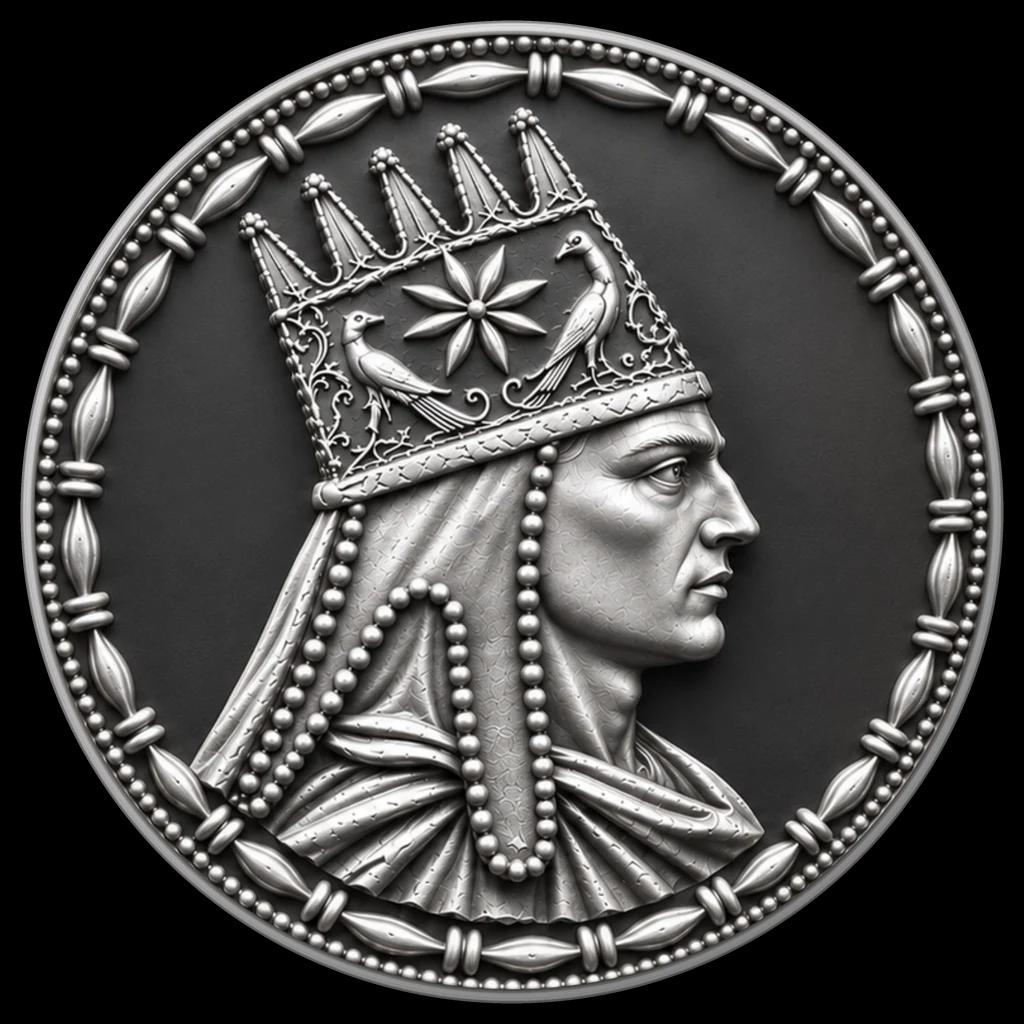
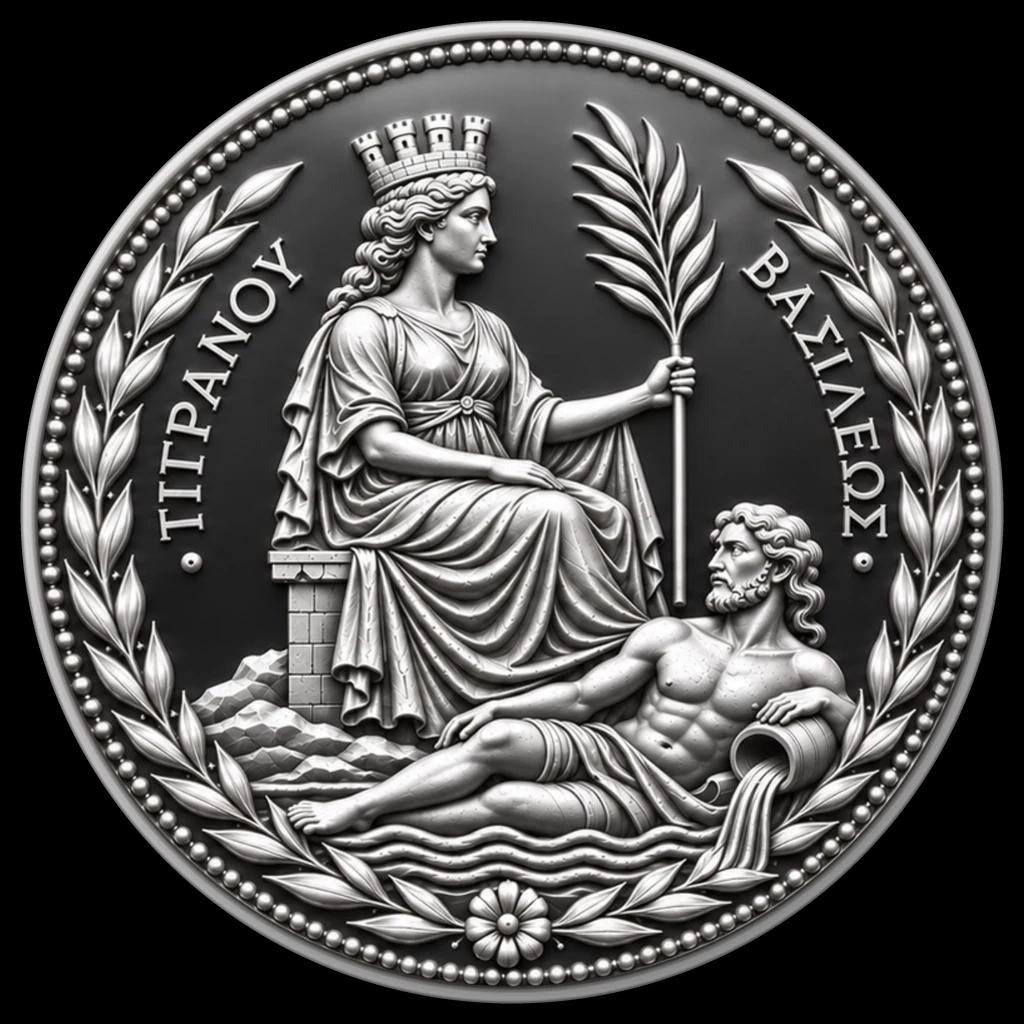
We know the face of Tigranes because he put it on his coins. His most famous issue is the silver tetradrachm struck at Antioch between 83 and 69 BCE, a coin of about 27 millimetres and 16 grams, examples of which are held today by the Fitzwilliam Museum, the Walters Art Museum and other collections.
On the obverse, Tigranes wears the tall Armenian tiara, crowned with points and decorated with a star between two eagles. Some researchers have suggested that the star records Halley's Comet, which passed in 87 BCE. On the reverse sits the Tyche, the protective goddess of Antioch, with the river god Orontes at her feet, surrounded by a laurel wreath and the Greek words ΒΑΣΙΛΕΩΣ ΤΙΓΡΑΝΟΥ, "of King Tigranes".
The coins join two worlds: Greek language and Hellenistic art, with an Iranian royal title and an Armenian crown. Our commemorative silver coin is a modern design inspired by this type; it is not an ancient coin.
Death and legacy
Tigranes ruled Armenia for about ten more years after his peace with Rome. He died around 55 BCE at a great age; the ancient writer Lucian says he lived to 85. His son Artavasdes II succeeded him.
His empire was short-lived, and historians still debate how solid it ever was. But its memory never faded. For Armenians, Tigranes the Great stands for the moment when their kingdom reached "from sea to sea". In the eighteenth century his name reached the European stage, in operas titled Tigrane by Alessandro Scarlatti, Antonio Vivaldi and Christoph Willibald Gluck, and today he remains one of the best-known figures of Armenian history.
Timeline
c. 140 BCE
Tigranes is born into Armenia's Artaxiad dynasty.
c. 120 BCE
Sent to Parthia as a hostage after Mithridates II defeats Armenia.
95 BCE
Becomes king, ceding "seventy valleys" to Parthia for his release.
c. 94 BCE
Unites Sophene with Armenia.
88–85 BCE
Campaigns against Parthia; takes the title King of Kings.
83 BCE
Enters Syria; Antioch accepts his rule.
80s BCE
Founds Tigranocerta as his new capital.
69 BCE
Lucullus defeats him and sacks Tigranocerta.
66 BCE
Submits to Pompey and keeps the Armenian throne.
c. 55 BCE
Dies at about 85; succeeded by Artavasdes II.
Questions about Tigranes the Great
When did Tigranes the Great rule?
From 95 BCE until his death around 55 BCE, about forty years. His empire was at its largest from about 83 to 69 BCE.
Why was he called King of Kings?
After his victories over Parthia in 88–85 BCE he took the old Persian royal title "King of Kings", which marked a ruler with other kings as his vassals. It appears on his coins after 85 BCE.
How large was his empire?
At its height it reached from the Caspian Sea to the Mediterranean, including Armenia, Syria with Antioch, Cilicia, Commagene and large parts of northern Mesopotamia and Media.
Where was Tigranocerta?
In the south of historic Armenia, in today's southeastern Turkey. The exact site is debated; current research considers Arzan, east of Diyarbakır, the most likely location.
What did his coins look like?
His silver tetradrachms show Tigranes in a tall Armenian tiara with a star between two eagles, and on the reverse the goddess Tyche of Antioch with the river god Orontes and the Greek words ΒΑΣΙΛΕΩΣ ΤΙΓΡΑΝΟΥ.
How did his empire end?
Allied with Mithridates VI of Pontus, he went to war with Rome. Lucullus took Tigranocerta in 69 BCE, and in 66 BCE Tigranes submitted to Pompey, giving up his conquests but keeping the throne of Armenia.
Sources
Most of what we know comes from Greek and Roman writers, who saw Tigranes as an ally of Rome's enemy. Modern scholarship reads them critically.
- Tigran IIEncyclopaedia Iranica (N. Garsoïan)
- Tigranes II the GreatEncyclopaedia Britannica
- The site of Tigranokerta: status quaestionisM. Marciak, Acta Antiqua 56 (2016)
- Tetradrachm of Tigranes II, Antioch, 83–69 BCEThe Fitzwilliam Museum, Cambridge
- Tetradrachm of Tigranes IIThe Walters Art Museum, Baltimore
- Life of Lucullus; Life of PompeyPlutarch (ancient source)
- Geography, Book 11Strabo (ancient source)